What Happens When You Add a Proton to an Atom
What is an atom? Facts about the building blocks of the universe
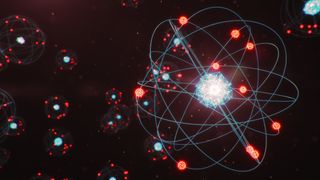
Atoms are the basic units of matter. Everything in the universe autonomously from energy is made of matter therefore atoms make upward everything in the universe, co-ordinate to Northwestern Academy. The term "atom" comes from the Greek give-and-take for indivisible, considering it was in one case thought that atoms were the smallest things in the universe and could non be divided. We now know that atoms are fabricated up of three particles known as subatomic particles: protons, neutrons and electrons — which are composed of even smaller particles, such as quarks.
Atoms were created afterward the Big Bang 13.7 billion years ago. As the hot, dumbo new universe cooled, weather condition became suitable for quarks and electrons to form. Quarks came together to class protons and neutrons, and these particles combined into nuclei. This all took place within the first few minutes of the universe's beingness, co-ordinate to CERN.
It took 380,000 years for the universe to cool enough to wearisome down the electrons and so that the nuclei could capture them to course the first atoms. The primeval atoms were primarily hydrogen and helium, which are still the most abundant elements in the universe, co-ordinate to Jefferson Lab. Gravity somewhen caused clouds of gas to coalesce and grade stars, and heavier atoms were (and still are) created inside the stars and sent throughout the universe when the star exploded (supernova).
Related: What is antimatter, how is information technology made and is it dangerous?
Diminutive particles
Protons and neutrons are heavier than electrons and reside in the nucleus at the eye of the atom. Electrons are extremely lightweight and exist in a cloud orbiting the nucleus. The electron cloud has a radius 10,000 times greater than the nucleus, according to the Los Alamos National Laboratory.
Protons and neutrons accept approximately the same mass. However, one proton is about 1,835 times more massive than an electron. Atoms always have an equal number of protons and electrons, and the number of protons and neutrons is ordinarily the same every bit well. Adding a proton to an atom makes a new chemical element, while adding a neutron makes an isotope, or heavier version, of that atom.
Nucleus
The nucleus was discovered in 1911 by Ernest Rutherford, a physicist from New Zealand, co-ordinate to the American Found of Physics. In 1920, Rutherford proposed the name proton for the positively charged particles of the atom. He also theorized that at that place was a neutral particle within the nucleus, which James Chadwick, a British physicist and student of Rutherford's, was able to confirm in 1932.
Virtually all the mass of an atom resides in its nucleus, co-ordinate to Chemistry LibreTexts. The protons and neutrons that make upward the nucleus are approximately the same mass (the proton is slightly less) and have the same angular momentum, or spin.
The nucleus is held together by the strong force, ane of the 4 basic forces in nature. This force between the protons and neutrons overcomes the repulsive electrical force that would otherwise push button the protons apart, according to the rules of electricity. Some atomic nuclei are unstable because the binding force varies for different atoms based on the size of the nucleus. These atoms volition and then decay into other elements, such equally carbon-fourteen decaying into nitrogen-14.
Protons
Protons are positively charged particles constitute inside atomic nuclei. Rutherford discovered them in experiments with cathode-ray tubes that were conducted between 1911 and 1919. Protons are about 99.86% every bit massive every bit neutrons co-ordinate to the Jefferson Lab.
The number of protons in an atom is unique to each element. For example, carbon atoms take half-dozen protons, hydrogen atoms take one and oxygen atoms accept 8. The number of protons in an cantlet is referred to as the atomic number of that element. The number of protons also determines the chemic beliefs of the element. Elements are bundled in the Periodic Table of the Elements in society of increasing atomic number.
Three quarks make up each proton — two "up" quarks (each with a 2-thirds positive accuse) and one "downwards" quark (with a one-tertiary negative accuse) — and they are held together past other subatomic particles chosen gluons, which are massless.
Electrons
Electrons are tiny compared to protons and neutrons, over i,800 times smaller than either a proton or a neutron. Electrons are about 0.054% equally massive as neutrons, co-ordinate to Jefferson Lab.
Joseph John (J.J.) Thomson, a British physicist, discovered the electron in 1897, according to the Science History Plant. Originally known equally "corpuscles," electrons have a negative accuse and are electrically attracted to the positively charged protons. Electrons surround the atomic nucleus in pathways called orbitals, an idea that was put forth by Erwin Schrödinger, an Austrian physicist, in the 1920s. Today, this model is known equally the breakthrough model or the electron cloud model. The inner orbitals surrounding the atom are spherical simply the outer orbitals are much more complicated.
An atom's electron configuration refers to the locations of the electrons in a typical atom. Using the electron configuration and principles of physics, chemists tin predict an atom'south properties, such as stability, boiling bespeak and conductivity, co-ordinate to the Los Alamos National Laboratory.
Related: What is quantum entanglement?
Neutrons
The neutron's being was theorized past Rutherford in 1920 and discovered by Chadwick in 1932, co-ordinate to the American Physical Guild. Neutrons were plant during experiments when atoms were shot at a thin sheet of beryllium. Subatomic particles with no charge were released — the neutron.
Neutrons are uncharged particles found within all atomic nuclei (except for hydrogen). A neutron's mass is slightly larger than that of a proton. Like protons, neutrons are also made of quarks — one "upwards" quark (with a positive two/3 charge) and two "down" quarks (each with a negative one-tertiary charge).
History of the atom
The theory of the atom dates at least equally far back every bit 440 B.C. to Democritus, a Greek scientist and philosopher. Democritus most likely built his theory of atoms upon the work of past philosophers, according to Andrew G. Van Melsen, author of "From Atomos to Cantlet: The History of the Concept Atom" (Duquesne University Press, 1952).
Democritus' explanation of the atom begins with a stone. A stone cut in one-half gives two halves of the same stone. If the stone were to exist continuously cut, at some point there would be a piece of the stone modest enough that information technology could no longer be cutting. The term "cantlet" comes from the Greek word for indivisible, which Democritus ended must be the bespeak at which a beingness (whatever grade of matter) cannot exist divided whatsoever more, according to educational website Lumen Learning.
His explanation included the ideas that atoms be separately from each other, that at that place are an infinite corporeality of atoms, that atoms are able to move, that they can combine together to create matter but do not merge to become a new atom, and that they cannot be divided, according to Universe Today. Notwithstanding, because most philosophers at the time — especially the very influential Aristotle — believed that all matter was created from earth, air, fire and h2o, Democritus' atomic theory was put aside.
John Dalton, a British chemist, congenital upon Democritus' ideas in 1803 when he put forth his own atomic theory, according to the chemistry department at Purdue University. Dalton's theory included several ideas from Democritus, such every bit atoms are indivisible and indestructible and that different atoms class together to create all matter. Dalton'due south additions to the theory included the following ideas: That all atoms of a certain element were identical, that atoms of one element will have unlike weights and properties than atoms of another element, that atoms cannot be created or destroyed and that matter is formed by atoms combining in simple whole numbers.
Thomson, the British physicist who discovered the electron in 1897, proved that atoms can be divided, according to the Chemical Heritage Foundation. He was able to determine the beingness of electrons by studying the properties of electric discharge in cathode-ray tubes. According to Thomson's 1897 paper, the rays were deflected inside the tube, which proved that there was something that was negatively charged within the vacuum tube.
In 1899, Thomson published a description of his version of the atom, commonly known as the "plum pudding model." An extract of this paper is found on the Chem Team site. Thomson'south model of the cantlet included a big number of electrons suspended in something that produced a positive charge giving the atom an overall neutral charge. His model resembled plum pudding, a pop British dessert that had raisins suspended in a round cake-like ball.
The next scientist to further modify and advance the atomic model was Rutherford, who studied under Thomson, according to the chemical science department at Purdue University. In 1911, Rutherford published his version of the atom, which included a positively charged nucleus orbited by electrons. This model arose when Rutherford and his assistants fired alpha particles at thin sheets of aureate. An blastoff particle is made upwards of ii protons and two neutrons, all held together by the aforementioned stiff nuclear force that binds the nucleus, according to the Jefferson Lab.
The scientists noticed that a small percentage of the alpha particles were scattered at very big angles to the original management of motion while the majority passed correct through hardly disturbed. Rutherford was able to approximate the size of the nucleus of the gold atom, finding it to be at least 10,000 times smaller than the size of the entire atom with much of the atom beingness empty infinite. Rutherford's model of the atom is withal the basic model that is used today.
Several other scientists furthered the diminutive model, including Niels Bohr (built upon Rutherford's model to include properties of electrons based on the hydrogen spectrum), Erwin Schrödinger (developed the quantum model of the cantlet), Werner Heisenberg (stated that ane cannot know both the position and velocity of an electron simultaneously), and Murray Gell-Mann and George Zweig (independently adult the theory that protons and neutrons were composed of quarks).
Boosted resources
- Read more about the early universe, from CERN.
- Learn more about the history of atomic chemistry in this video from Khan Academy.
- Check out this usefultive slide show about atoms from the Jefferson Lab.
Source: https://www.livescience.com/37206-atom-definition.html
0 Response to "What Happens When You Add a Proton to an Atom"
Post a Comment